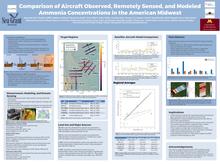
The University of Minnesota Tall Tower Trace Gas Observatory is a long‑term atmospheric measurement site designed to quantify greenhouse gases, reactive nitrogen, and biosphere–atmosphere exchange processes across the Upper Midwest. The observatory has been supported by the National Science Foundation (Lower Atmosphere Chemistry Program), the U.S. Department of Energy (Office of Science, BER), the U.S. Department of Agriculture (NIFA), and is currently supported by the National Oceanic and Atmospheric Administration (NOAA) to enable long‑term methane monitoring and regional CH₄ inverse analyses. We gratefully acknowledge Minnesota Public Radio (KCMP 89.3 “The Current”) and their continued logistical support.
Location and Infrastructure
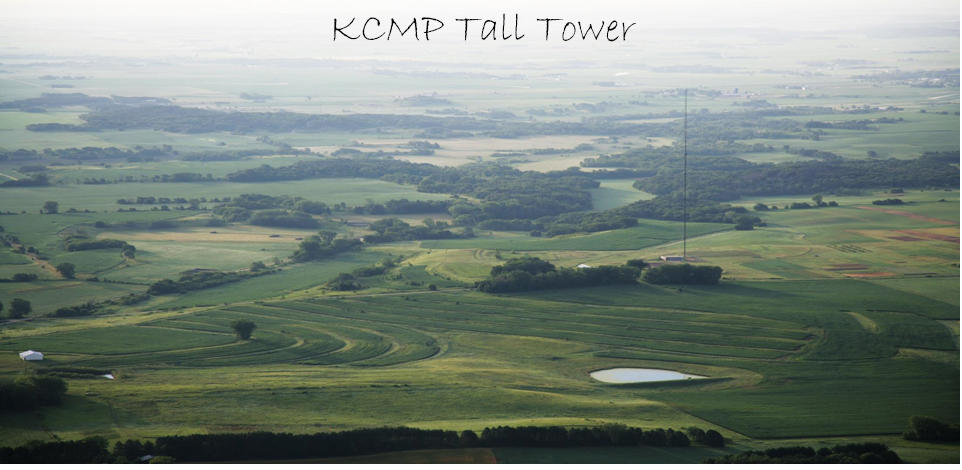
The observatory is located approximately 25 km south of the Minneapolis–Saint Paul metropolitan area at the KCMP radio tower (44°41′19″ N, 93°40′22″ W; 290 m ASL). The site provides a unique vantage point for sampling regional atmospheric composition, boundary‑layer dynamics, and agricultural emissions across one of the most intensively managed landscapes in North America.

Measurement Program
Continuous measurements began in April 2007, making this one of the longest‑running university‑operated tall‑tower greenhouse‑gas datasets in the United States. The tower is instrumented at 32, 56, 100, and 185 m, enabling vertical profiling of trace gases and meteorological variables.
Key components of the measurement system include:
- Greenhouse gases — High‑precision measurements of CO₂, CH₄, N₂O, and H₂O using cavity‑enhanced spectroscopy. NOAA support currently sustains the long‑term CH₄ record and enables regional methane inversion analyses that quantify emissions from agriculture, wetlands, and energy systems.
- Turbulence and boundary‑layer structure — CSAT3 sonic anemometers at 100 m and 185 m provide 20 Hz turbulence measurements for flux estimation, footprint analysis, and evaluation of atmospheric stability regimes.
- Reactive nitrogen — Near‑continuous NH₃ observations have been collected since March 2017 using an off‑axis cavity ring‑down spectrometer with enhanced thermal stabilization to minimize drift. These measurements provide critical constraints on agricultural emissions, deposition processes, and ammonia’s role in aerosol formation.
- Planetary boundary‑layer — A Vaisala ceilometer provides continuous retrievals of boundary‑layer height, aerosol backscatter, and mixing‑layer evolution. These data are essential for interpreting tall‑tower trace‑gas gradients, diagnosing transport regimes, and constraining CH₄ and N₂O inversions by providing real‑time information on atmospheric mixing depth and entrainment processes.
Scientific Contributions
The tall‑tower observatory has supported advances in:
- regional greenhouse gas flux estimation
- long‑term nitrous oxide and methane inversion analyses
- indirect and direct estimates of N₂O emissions
- assessment of ammonia emission inventories
- isotope‑enabled source attribution of carbon dioxide and nitrous oxide
- boundary‑layer dynamics and transport modeling
- multi‑tower atmospheric inversions for CH₄ and CO2
The long‑term continuity of the dataset makes the site a cornerstone for understanding agricultural–atmosphere interactions and evaluating mitigation strategies in the Upper Midwest.

Please visit our data resource page for any data sets related to these tall tower measurements.
Posters and Presentations
This document was created before current policy requirements took effect, and therefore may not be accessible. To request this content in an accessible format, contact [email protected].